|
The Nigeria Brief
Sunday Edition · June 14, 2026
|
| |
Editor's Note
Nigeria's natural resource wealth is one of the most discussed and least understood facts about the country. Gbadebo Adeyemi takes stock of what Nigeria actually sits on — and asks the question every Nigerian parent has asked a child who should be doing better.
|
|
|
|
NIGERIA IS RICH!
|
|
Well…sort of. You know that conversation, the one where you try to convince someone who's going through a rough time financially, that wealth is more than money? Or worse, if you're unlucky, the conversation someone has had with you. That's Nigeria's story, in a way.
Nigeria is definitely not one of the wealthiest countries on earth by any financial metric, but it has wealth, just a different kind. Nigeria is wealthy in oil, nothing new here. Oil has brought the country many great things, but it's also been the source of so much evil. This isn't about oil though; it's about everything else. Coal, natural gas, gold, iron ore, columbite and bitumen are abundant in Nigeria. And that's not all.
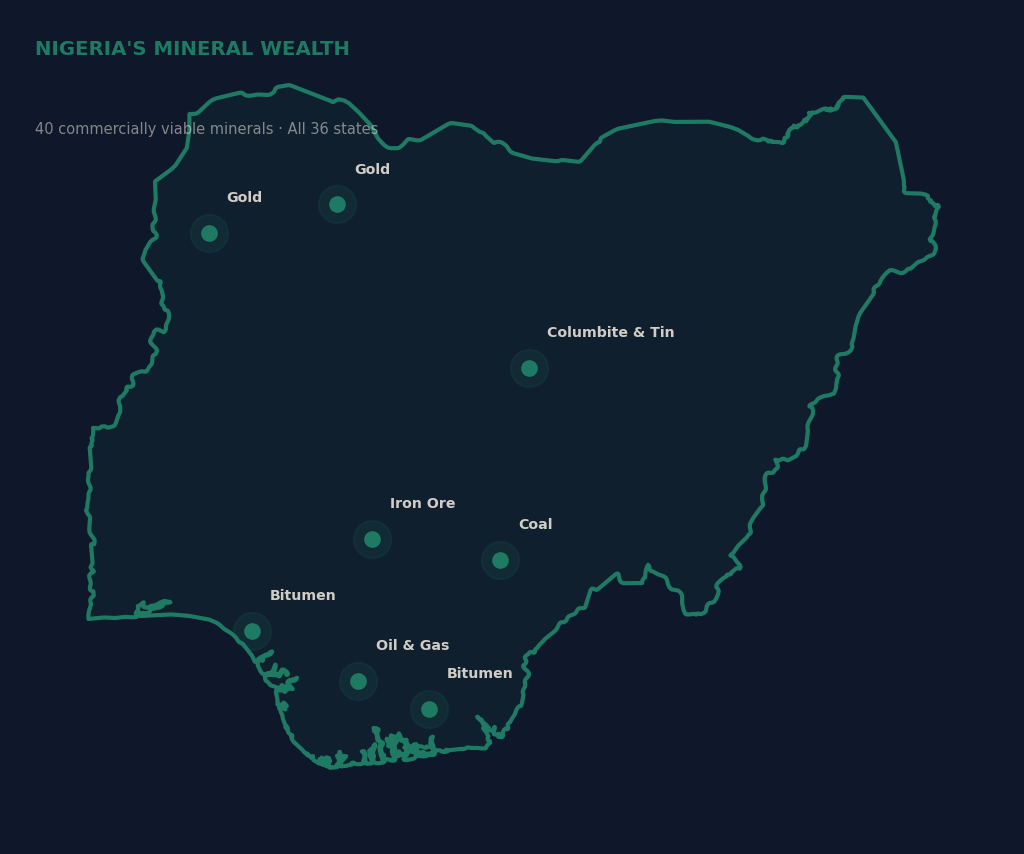
Let's lay it out. Nigeria has at least 40 types of commercially viable minerals, and they're found across all 36 states. Every. Single. One.
|
| |
Oil & Gas
We'll start with the obvious: oil in the Niger Delta. States like Rivers, Bayelsa, Delta, Akwa Ibom, Ondo, and Edo sit on the bulk of it.
|
Crude Oil Reserves
37B barrels
Proven reserves — NUPRC 2025
|
|
Natural Gas
210 TCF
Largest reserves on the continent
|
Locally, that gas powers the turbines behind Nigeria's electricity generation — and yes, I know there's still no constant electricity, but stay with me. Internationally, it leaves our shores as Liquefied Natural Gas, LNG, and goes to buyers around the world. These account for about 88% of the country's export revenue.
|
|
| |
Iron Ore & Steel
Move north to Kogi State and you hit iron ore. The Itakpe Iron Ore Mine holds an estimated 200 million metric tonnes of minable reserves — one of the most significant deposits in West Africa. Iron ore is what you smelt into steel. It forms the backbone of every bridge, building, and vehicle in the modern world.
The federal government built the Ajaokuta Steel Company right next to those deposits, which was supposed to turn raw Nigerian ore into finished Nigerian steel. That was 1979. As of today, it's still not fully running. But, I digress.
Travel to Jos in Plateau State, and you find tin and columbite, the ore from which niobium is extracted. Niobium is a strategic metal used to strengthen steel and produce high-performance alloys for aircraft engines, pipelines, and advanced technologies, including the superconducting magnets used in MRI machines.
Then there's bitumen spread through a belt across Ondo, Ogun, Lagos, and Edo states. Gold runs through Zamfara, Kebbi, Osun, and Niger states. Coal lies beneath Enugu, Kogi, and Benue. And limestone in Kogi, Benue, Ogun and Cross River states.
|
|
| |
Columbite & Niobium
Here's where it gets really interesting. Think about modern infrastructure for a second — the high-strength steel in bridges and oil pipelines, the alloys in jet engines, the superconducting magnets inside MRI machines. All of it depends, in part, on niobium, refined from columbite ore.
Brazil produces close to 90% of the world's niobium supply. A single Brazilian company, CBMM, supplies steel manufacturers, aerospace companies, and electronics firms across the globe, generating billions of dollars in export revenue every year.
And Nigeria? Nigeria sits on some of the world's most significant columbite deposits, but that potential has barely been touched. In the 20th century, we were one of the largest columbite producers in the world. Today, the industry is a shadow of what it once was.
|
|
| |
Gold
Ghana has built a significant part of its modern economy on gold. It consistently accounts for more than half of all Ghana's total export revenues — over 55% in recent years, and climbing. That's why they were called the Gold Coast, a name worn before independence and a name it still earns today.
Nigeria has comparable gold deposits spread across Zamfara, Kebbi, Niger, and Osun states. But most of those deposits remain underexplored or, in Zamfara's case, actively being illegally mined — with little of the benefit flowing back to the state or its people.
|
|
| |
Bitumen
Trinidad and Tobago has the famous Pitch Lake, a sprawling natural asphalt deposit that has helped fund infrastructure across that small island nation for over a century. The country has 10 million tonnes of bitumen reserves.
|
Nigeria imported
$320M
worth of bitumen in 2024
|
|
Nigeria sits on
42B tonnes
of bitumen reserves
|
The irony would be funny if it didn't cost us so much money.
|
|
| |
The Full Picture
So, let's put this all together. Nigeria has 37 billion barrels of crude oil. 210 trillion cubic feet of natural gas. Hundreds of millions of tonnes of iron ore, coal, and limestone. 42 billion tonnes of bitumen. Gold across the northwest and southwest. Columbite that global steel, aerospace, and high-tech industries depend on. Forty minerals. Thirty-six states. All of it.
Countries with far fewer resources — Botswana with diamonds, Chile with copper — have built functioning systems around a single resource and transformed their economies.
Nothing about this has to stay the way it is. The ore is in the ground. The gold is in the soil.
|
Invest in processing. Crackdown on illegal mining. Create a government that takes solid minerals half as seriously as it takes oil — that's what changes the story.
|
The resources are there. They've always been there.
So, the article started with an image — someone convincing another that wealth is not about money. Maybe, a more suitable image is one where a mother, who has just come home from a 10-hour work day, plus the usual hour in traffic, and who has not eaten, comes home to see her child's report card and realises that not only is the child not top of the class, but that the child's friends all finished in higher positions. Then she asks the question that millions of kids have heard time and time again.
|
|
| |
"Do they have 2 heads?"
Maybe it's time to ask Nigeria that question.
|
|
|
|
|
References
|
|
|
▪ Follow us on Instagram and X (Twitter) for daily updates.
▪ Missed an edition? The full archive is right here.
▪ Found this useful? Forward it to someone who'd appreciate it.
|
|
The views expressed in this essay are those of the contributor and do not necessarily represent the position of Frontier Brief Media.
|


