We Were Told to Leave Home. Now We're Trying to Find Our Way Back.
There is a particular reaction Nigerians get when they say, “I moved to Italy for my master’s.” “Oh, Italy? You’re enjoying.” It is usually said with affection, but it also reveals something about how we understand leaving. Certain countries have become shorthand for progress: Europe means opportunity, Britain means stability, America means possibility. Nigeria, by contrast, is often spoken about as though remaining requires an explanation.
I left Nigeria in 2023 to begin my master’s in Italy. I was excited, grateful and, if I am honest, slightly frightened. I was leaving to study because I believed education could make me more useful to the country I came from. Then Nigeria changed around me.
|
Economics, But Make It Personal
|
Bola Ahmed Tinubu became Nigeria’s sixteenth president on May 29, 2023. In his inaugural address, he announced the end of the petrol subsidy regime and spoke of moving toward a unified exchange rate.1 I had only just been learning economics, so the subject stopped being something contained in lecture notes. It became part of my family’s financial reality.
One of the most important ideas in economics is that people respond not only to present conditions, but also to expectations about the future. If households and firms anticipate higher costs, they adjust their spending, pricing and plans. Policy therefore operates partly through expectations: an announcement can alter behaviour before its full effects have even worked through the economy. For Nigerians, the consequences felt immediate. The subsidy removal increased petrol prices, while foreign-exchange reforms changed the environment in which the naira was priced. By the first half of 2023, the Central Bank of Nigeria recorded the naira depreciating by 15.8 percent against the euro and 14.6 percent against the pound.2
For me, those percentages had a face. My school fees were in euros. I would sit with a calculator, convert the amount into naira, stare at the result and calculate it again because surely I had missed something. Sometimes even buying a bottle of water became a small financial debate. Jesus! Thank You for deliverance!
The point is not that one presidential announcement created every difficulty Nigeria was experiencing. It did not. The country’s economic challenges were structural and had accumulated over years. But policy decisions can change expectations rapidly, and those expectations can shape the everyday decisions of people who have very little room to absorb another increase in cost. For a young Nigerian studying abroad, exchange rates cease to be abstract figures. They become school fees, rent, food, transport and guilt.
Italy gave me another lesson: leaving Nigeria does not automatically mean life becomes easy. Italy has extraordinary cultural wealth and opportunities. It also has bureaucracy, corruption and organised crime.3 It has young people who leave for work elsewhere. Italians themselves migrate, including to Britain, the United States and other European countries.4 That did not make Italy less beautiful; it simply made the country more real.
My immediate challenge was ordinary. I was a foreigner trying to find work where I did not yet understand the language or systems. So I left again, this time to the United Kingdom. English was thankfully familiar; the weather was colder, the currency stronger, and the rooms smaller. The joke remained: convert every purchase into naira and emotionally damage yourself.
|
The Foreign Dream Has A Catch
|
I did not originally leave Nigeria because I wanted to “JAPA.” I left because I wanted an education. There is a difference. For many Nigerians, migration is not simply an escape. It is a strategy. Obtain the degree. Build capital. Gain experience. Learn systems that work differently. Establish networks. Return with something that can be applied at home.
Migration can produce both loss and gain. When skilled people leave, the country loses some human capital. Yet migrants can also send money home, build businesses, transfer knowledge and maintain professional networks across borders. The question, therefore, is not simply whether Nigerians leave, but what leaving becomes: temporary mobility, long-term settlement, survival or the pursuit of a future that no longer seems possible at home.
Migration is also shaped by comparison. Once young people can see how peers elsewhere live, study and work, dissatisfaction is no longer measured only against yesterday; it is measured against possibilities visible every day. Social media has made that comparison unavoidable. Leaving can therefore feel less like an extraordinary decision and more like the rational next step, especially when institutions appear unable to convert education into opportunity. It can also make home appear smaller than the world outside it, when opportunity, dignity and institutional trust seem easier to imagine elsewhere.
Somewhere along the way, however, the plan can quietly change. “I am leaving to study” becomes “I need to gain experience here before I move back.” “I need to gain experience here before I move back” becomes “I need a better passport before I return.” “I need a better passport before I return” becomes “perhaps next year.” Then the years pass. Eventually, “I’ll return soon” becomes one of those sentences Nigerians abroad repeat with remarkable confidence.
The question is what happens when movement becomes the default definition of progress rather than a response to necessity. At what point does “I am leaving for now” become “I am never coming back”?
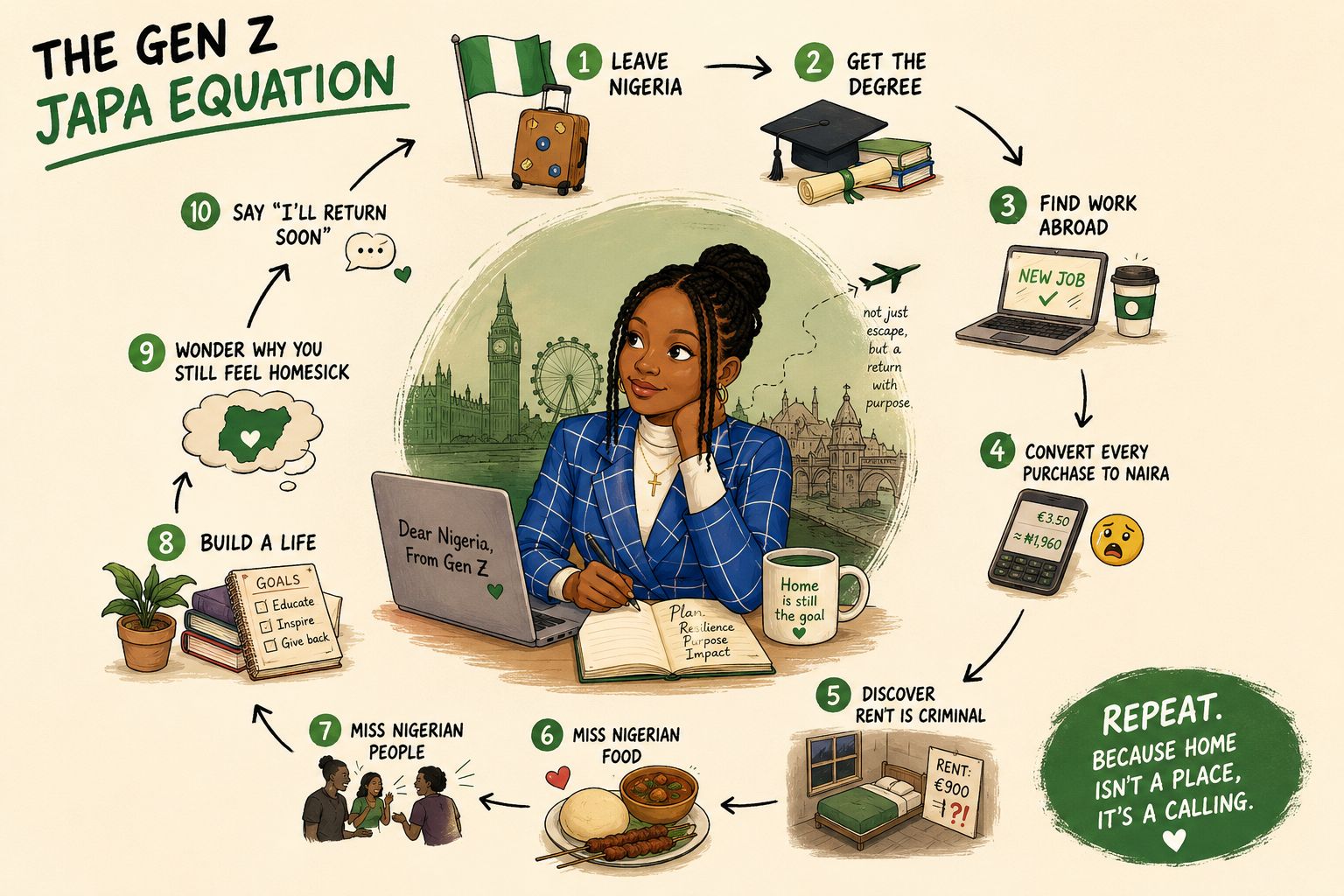
THE GEN Z JAPA EQUATION
Leave Nigeria → Get the degree → Find work abroad → Convert every purchase to naira → Discover rent is criminal → Miss Nigerian food → Miss Nigerian people → Build a life → Wonder why you still feel homesick → Say “I’ll return soon” → Repeat.
The question is what happens when movement becomes the default definition of progress rather than a response to necessity. At what point does “I am leaving for now” become “I am never coming back”?
The foreign dream can be good. I do not want to romanticise Nigeria simply because I miss it. Some Nigerians abroad are safer, more stable and able to build the lives they want. Some should remain abroad. Some cannot return. Some have responsibilities that make returning unrealistic. But we should still question a society in which leaving has become the most believable form of progress.
|
Maybe We Did Not Lose Our Ability
|
Living outside Nigeria has made me notice something uncomfortable. The qualities we sometimes say Nigerians lack at home do not disappear when Nigerians cross a border. The resilience remains. The resourcefulness remains. The creativity remains. The willingness to work remains. The kindness remains. The ambition remains. The excellence remains.
Nigerians abroad build companies, excel in universities, work in hospitals, create art, solve problems, lead organisations and support families across continents. The same people who can be frustrated by weak systems at home can become remarkably disciplined and innovative when the surrounding environment rewards those qualities. That does not mean the problem is simply the environment. Individuals have agency, and societies require standards, responsibility and accountability. But it is worth asking what becomes possible when ability meets functioning institutions.
This is why I struggle with the idea that patriotism means returning home regardless of circumstances. Loving Nigeria does not require pretending that Nigeria is working perfectly. Nor should returning mean coming back empty-handed, exhausted or determined to reproduce the same systems that made leaving necessary. Perhaps the goal is not to make every Nigerian return. Perhaps it is to make return one of several believable futures.
There is a reason the story of the prodigal son still feels familiar. He left home. He wanted something elsewhere. He discovered that distance does not automatically produce fulfilment. And eventually, he looked back.
I am not suggesting every Nigerian abroad is a prodigal son or daughter. The comparison simply captures a tension many of us understand: “I need to leave” and “I miss home” can both be true. I miss being understood without explaining myself. I miss the noise. I miss family. I miss garri, noodles, suya, pounded yam and ogunfe. Amala is still a no-no, dear. I have standards. I miss festive periods when somebody somehow finds a way to produce enough food for an army, and there is plenty of meat because, frankly, I like meat. But I miss something deeper too: the feeling that home is mine.
Perhaps that is why I am writing this from a distant land. I left Nigeria hoping education would make me better equipped for home. Somewhere along the way, “better equipped” quietly became “better off here.” That distinction matters. Some of us may return with degrees. Some with capital. Some with businesses. Some with skills. Some with ideas. Some with nothing but the stubborn conviction that Nigeria can be different.
I no longer want to measure success only by how far I have travelled from Nigeria. I want, eventually, to measure it by what I can carry back. Maybe my homesickness is not only homesickness. Maybe it is responsibility knocking.
So what happens when the generation that learned how to leave finally learns that it can also return? Because before we answer that, we need to ask a more difficult question: when did Nigeria become a place we were so determined to escape? That, dear reader, is where we begin next.
| 1. State House, Abuja: “First Inaugural Address by President Bola Ahmed Tinubu Delivered on May 29, 2023 at the Eagle Square, Abuja,” May 29, 2023. The address records the end of the petrol subsidy regime and calls for a unified exchange rate. |
| 2. Central Bank of Nigeria: Half Year Economic Report, 2023, “Exchange Rate Movements.” The report records a 15.8 percent depreciation of the naira against the euro and a 14.6 percent depreciation against the British pound in the first half of 2023. |
| 3. Direzione Investigativa Antimafia: “Relazione sull’attività svolta e risultati conseguiti nel 2024,” presented to the Italian Parliament, May 27, 2025. The report documents continuing activity by mafia-type organised crime groups in Italy. |
| 4. Istituto Nazionale di Statistica (Istat): “Gli italiani residenti all’estero - Anni 2023 e 2024,” July 23, 2025. Istat reports 156,000 Italian expatriations in 2024 and identifies Germany, Spain, the United Kingdom, Switzerland and France as the principal destination countries. |