In my previous article, I asked when Nigeria became a place so many of us felt we had to escape. I left in 2023 for a master’s degree in Italy, carrying the Nigerian-parent survival dream plan: get a good education, find opportunity, and spare your children the struggle you knew. However, education abroad can feel less like a dream and more like an escape pod.
Over time, I began noticing how differently we describe ourselves depending on where we are. At home, a person may first be introduced by tribe, state, language or religion. Abroad, the introduction can become simpler: Nigerian. Sometimes African. Sometimes Black. But to help answer the question from my previous article, let’s explore how Nigeria was conceived.
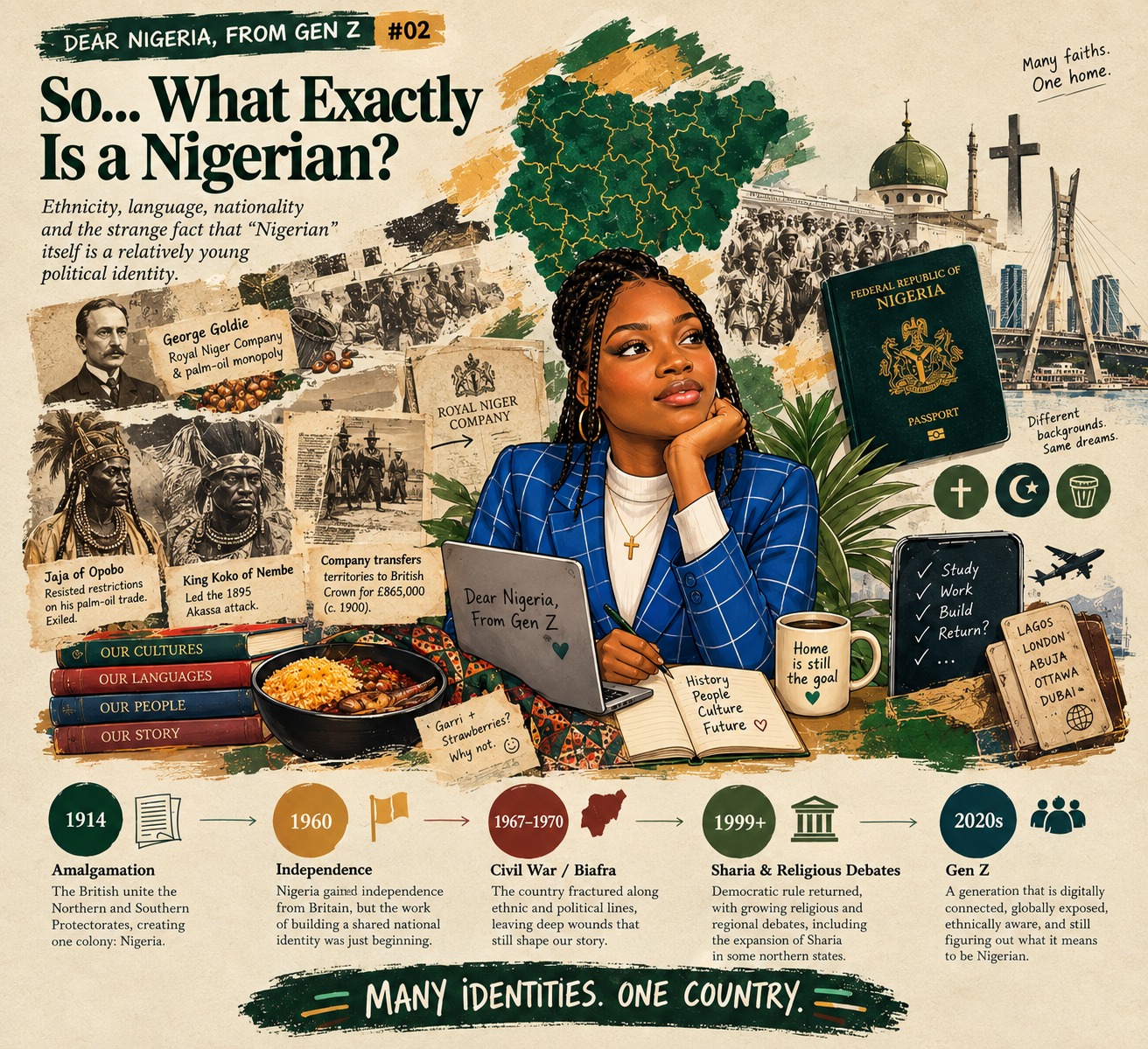
Nigeria did not create the peoples within its borders. Borno, Sokoto, Oyo, Benin and other societies had their own political systems, languages and ideas of belonging long before the modern state. European imperial expansion forced many of these communities into a colonial framework shaped by commercial and strategic interests. These interests became the Royal Niger Company’s trading power, which became entangled with British territorial ambitions; the company transferred its territories to the British government for £865,000, effective 1 January 1900. Then along the way in 1914, the British amalgamated the Northern and Southern Protectorates under one administration. A shared administration that did not instantly create a shared identity.1
Basically, we inherited a country politically joined before everyone had agreed on what joining meant. This is not the whole story, nor an excuse to deny our agency today. Still, it’s like eating Garri with Strawberries; what could possibly go wrong when many histories are put in one country and the children are left to figure out the group chat?
THE NIGERIAN IDENTITY MAP
1914 to the 2020s. Timeline labels: 1914 amalgamation • 1960 independence • 1967–1970 civil war • 1999 democratic transition • 2020s Gen Z reimagines belonging.
Then came the “joke, sorry, independence” of 1960. Independence mattered, but coups, regional competition and the 1967–1970 Biafran War left deep wounds. That war cannot be reduced to tribes fighting. Political ambition, military decisions, regional interests and ethnic identity all interacted, while ordinary people paid the price.2 The memories travelled through families, warnings, jokes and silences.
Here is where the history becomes personal for me. My mother is Kogi. Some of my best friends are Igbo. I have an Edo soul sister, a South-South in-law, a northern-based sister and northern friends who are also my food plugs and professional market-price negotiators. We have friendships that are not built around a shared ancestry. They are built around showing up, gist, food, loyalty, laughter and the ability to say, “Please, help me price this thing,” without shame. Can we turn this everyday closeness into a wider habit of citizenship together?
My circle stretches beyond Nigeria: friends from South Africa, Cameroon, Sudan, Zimbabwe, Ghana, America, Italy, Korea and China have become family. Ethnicity still matters, but it is rarely the only thing that matters in my actual life. I cannot reduce a friend I love to the label someone online thinks should explain them.
I cannot speak the indigenous language I supposedly inherited fluently. Many parents prioritised English to give us options; I understand the love behind that choice. But in preparing us for the world, we sometimes became less fluent in parts of home. People can hear where I am from before I can speak the language that helped make me who I am.
Then I open social media and see “Yoruba people…” or “Igbo people…” followed by a digital battlefield, and I wonder whether social media is keeping some old arguments alive long after everyday life has become more mixed. Gen Z has not magically outgrown ethnic prejudice. We can be tribal, too; we just have better memes and faster Wi-Fi. But many of us also study, work, date, marry and build friendships across boundaries that older generations sometimes treated as warnings. And yes, if you shout Ghana, I will shout “eggs!” I have principles.
A 2024 Afrobarometer working paper by Daniel Tuki found that ethnic discrimination in Nigeria can strengthen the importance people attach to ethnic identity over national belonging.3 When people feel excluded, they may retreat toward the group they believe will protect them.
|
What Changes When We Leave?
|
My amazing editor shared with me the study by sociologist Onoso Imoagene, “The Nigerian Second Generation at Work in Britain.” It draws on interviews with 73 upwardly mobile adults born or raised in Britain to Nigerian parents and examines their workplace experiences. Imoagene distinguishes direct discrimination—being denied opportunities or resources—from stigmatisation: moments when a person’s dignity or worth is questioned. In her sample, stigmatising experiences were more common than clear-cut incidents of racial discrimination, and the ways participants understood those experiences were shaped by British history, national identity and class.4
This is not a direct comparison between ethnic discrimination inside Nigeria and discrimination abroad. It studies second-generation Nigerians in British workplaces, where race, nationality, class and outsider status can overlap. At home, someone might ask, “Which tribe are you?” In Britain, a Nigerian might be asked where they are really from or have their competence questioned because of race or accent. These are not identical experiences, but both raise the question: who gets to belong without explaining themselves first?
Leaving can change which identity is most visible, but it does not guarantee acceptance. Abroad, “Nigerian” may unite people separated by ethnic labels at home. Yet a shared passport does not erase differences. We may discover solidarity in a new place while carrying old suspicions with us. Distance can expose inherited divisions; it cannot unlearn them for us.
|
And Then There Is Religion
|
Religion adds another layer. Islam has deep roots in northern Nigeria, Christianity spread through missionary activity, and indigenous beliefs shaped communities across the country. Debates about Sharia, constitutional authority and religious freedom have sometimes become entangled with political power.5 But a history of conflict does not make every neighbour of another faith a threat.
I am a passionate Christian, so let me say this plainly: I cannot reconcile hatred of another Nigerian because they worship differently with the Christ I follow. I have heard inherited suspicions that people from another faith or region cannot be trusted. But my Gen Z friendships complicate that story. I have seen kindness, loyalty and generosity without anyone first checking whether we worship alike. The person beside me is not a political theory. They are a person!
I do not ignore violence or pretend religion has never been used to mobilise people for power. I refuse to treat the worst thing done in the name of a faith as a complete description of everyone who follows it. Ziya Meral’s book How Violence Shapes Religion… is useful because it examines how belief interacts with politics and social context.6
@moderndaytowncrier and @_the_merc on Instagram are people that also send me down historical rabbit holes on Nigeria’s past, which leaves me wondering why some of these conversations were never properly taught in school (yes, I’m Gen Z, and social media is also a news source to us)… jokingly serious.
Being Nigerian does not mean my faith should be vague. It requires me to ask whether my behaviour resembles the love I profess. If I sing about loving my neighbour on Sunday and treat a Muslim, traditional worshipper or Christian from another denomination as less Nigerian on Monday, I have failed to practise what I claim to believe.
|
So, What Exactly Is a Nigerian?
|
Using a Gen Z lens, perhaps a Nigerian is someone learning to hold several identities without allowing one to cancel the others. We are Yoruba and Nigerian, Igbo and Nigerian, Hausa and Nigerian, Tiv and Nigerian; Christian, Muslim, traditional and diaspora Nigerians. We can love our languages without demanding that everyone speak them, and remember wounds without turning them into permanent instructions for how to treat one another.
Our parents told many of us to leave because they wanted to protect us. Many of us discovered that pain does not stop at immigration control. Distance offers perspective: we see Nigeria’s beauty more clearly and notice that other countries have fractures too. We miss the food, humour, family, faith and familiarity we once took for granted.
Perhaps that is why Gen Z laughs so much. Tell us the economy is collapsing and someone makes a song. Give us a difficult politician and suddenly he is a dancer, a sassy diva or a meme. We turn lamentation into comedy, skits and dance challenges. Take out our legs and we crawl; cut off our hands and somebody will invent the earthworm dance.
It is funny because it is absurd. It is also a way of surviving what we cannot immediately fix.
Underneath the laughter is a serious choice. We did not choose the country we inherited or live through every wound that shaped our parents, but we live with the consequences and can decide what to pass on.
Maybe that is enough reason to keep asking better questions of ourselves. Which brings us back to the question we have deliberately left unfinished: if our tribes existed long before Nigeria, why are we still allowing them to decide who we trust, love, marry, employ and call our own? That, dear reader, is where we go next.
AUTHOR'S NOTE
The article distinguishes between ethnic discrimination within Nigeria and racial or ethno-racial exclusion experienced by Nigerians in Britain. The available studies do not offer a direct like-for-like comparison; the essay uses them to ask how belonging changes across contexts, not to claim that one place is free of prejudice.
| 1. For the Royal Niger Company and the 1914 amalgamation, see “Who Sold Nigeria to the British for £865k?” Guardian Nigeria; and “How Nigeria Transformed from a Business into a Country,” Pulse Nigeria. The company’s corporate history passed through the Niger Company and United Africa Company before Unilever control; it did not simply become Unilever overnight. |
| 2. Miriam Bradley, “The Nigerian Civil War, 1967–70,” in The Politics and Everyday Practice of International Humanitarianism (Oxford University Press, 2023). Estimates of deaths vary; many accounts place the toll as high as two million, largely from starvation and disease. |
| 3. Daniel Tuki, “You’re Not Like Us! Ethnic Discrimination and National Belonging in Nigeria,” Afrobarometer Working Paper 206 (December 2, 2024). |
| 4. Onoso Imoagene, “The Nigerian Second Generation at Work in Britain: Ethnoracial Exclusion and Adaptive Strategies,” Sociology 53, no. 2 (2019): 264–279. Based on interviews with 73 second-generation Nigerian adults in Britain. This study is not a direct comparison with ethnic discrimination within Nigeria. |
| 5. Ibrahim Na’iya Sada, “The Making of the Zamfara and Kano State Sharia Penal Codes,” in Philip Ostien, ed., Sharia Implementation in Northern Nigeria 1999–2006 (Spectrum Books, 2007). |
| 6. Ziya Meral, How Violence Shapes Religion: Belief and Conflict in the Middle East and Africa (Cambridge University Press, 2018). |
Historical social media references, including
@moderndaytowncrier and
@_the_merc, are treated as prompts for further curiosity rather than authorities for factual claims.