Your Tribe Is Older Than Nigeria. So Why Are We Fighting Over It?
| The Elephant We Keep Avoiding |
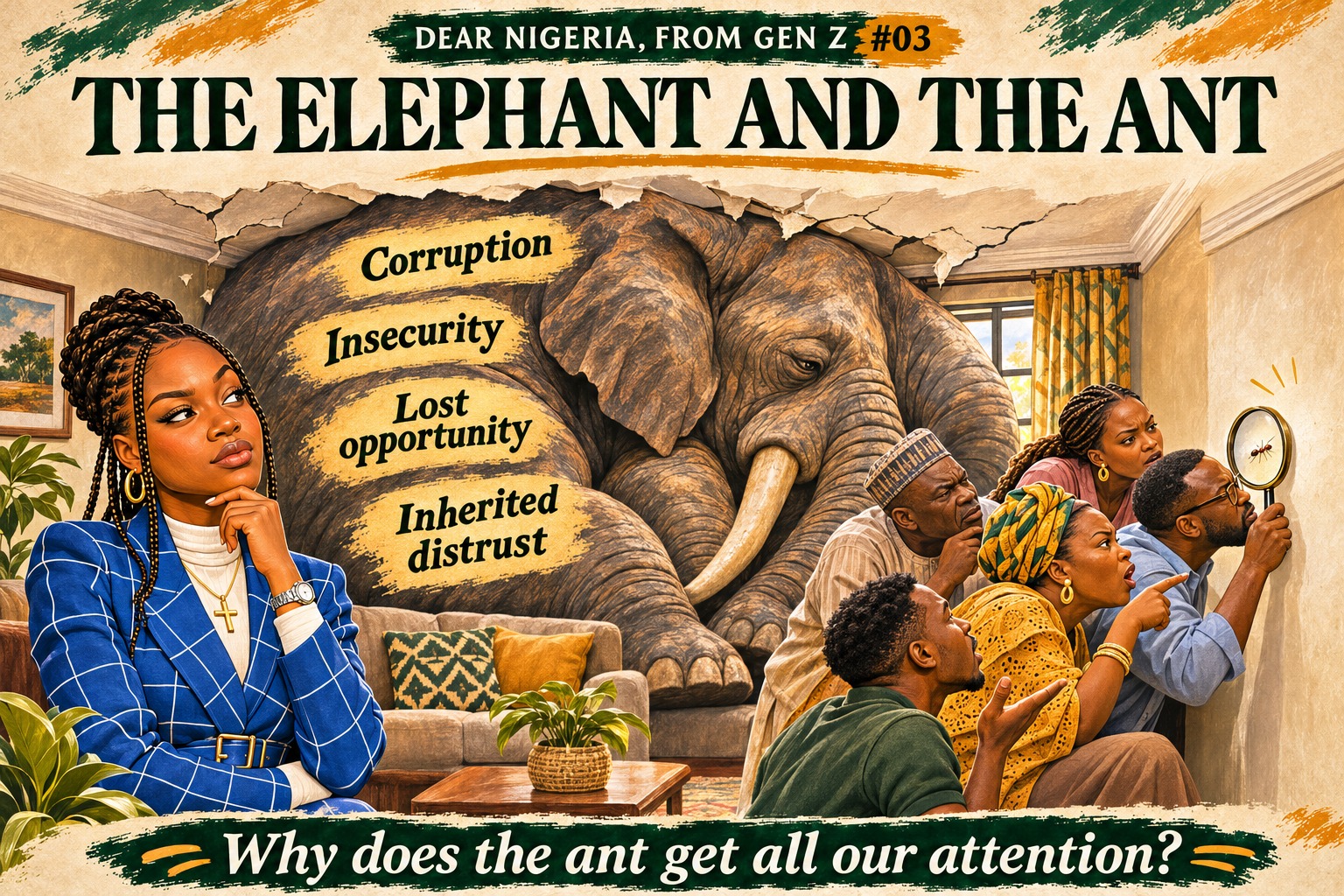
Previously, I explored Nigeria’s young nationality and our older identities. I ended by asking why tribe still decides whom we trust, love, marry, employ and call our own. My answer begins with an uncomfortable possibility: sometimes, attacking another community is easier than confronting the conditions making all our lives difficult. The elephant occupies the room, but we are fighting the ant on the wall. At least the ant looks manageable.
Many of our communities predate Nigeria, although their identities have changed over time. Their age is not the problem. The trouble begins when belonging becomes permission to mistreat somebody else. Somehow, electricity can disappear without explanation, but an Igbo person marrying a Yoruba person requires an emergency family summit. Priorities, dear reader. Priorities.
Imagine an elephant squeezed into your sitting room: furniture breaking, doorway blocked, everyone uncomfortable. Yet the household is investigating one ant crawling on the wall. An elephant could wreck your car; the ant crossing its bonnet could not. We have reversed their importance because the smaller thing looks easier to overpower. The elephant is impossible to miss. Acknowledging it, however, means admitting what is broken, what embarrasses us and sometimes how we contribute to the damage.
The elephant has recognisable features: insecurity, blocked opportunity, unaffordable living and institutions that too often fail to protect us fairly. Afrobarometer’s analysis of its 2024 Nigeria survey found that respondents aged eighteen to thirty-five prioritised the cost of living, unemployment and insecurity. This age group includes more than Gen Z, but its concerns are familiar.1 Your neighbour’s surname does not repair the power supply.
Mr Molade Dairo offered a thoughtful response to the previous article: younger Nigerians are not magically nicer. Mixed cities, university hostels and digital friendships can create different relationships, while exclusion from old patronage networks can weaken loyalty to them. He described tribalism as an insurance policy where national belonging has not reliably paid out. History, inherited trauma and political manipulation reinforce that retreat.
That explanation deserves attention. Sociologist Peter Ekeh’s account of Africa’s “two publics” helps explain how obligations to community can coexist with weaker moral obligations towards state institutions.2 Someone may condemn stealing from a neighbour while excusing diversion of public resources when “our people” benefit. The national purse apparently becomes communal takeaway. Political scientist Daniel Posner’s study of Chewa and Tumbuka communities in Zambia and Malawi similarly shows how political incentives shape the importance of cultural differences.3 We are not genetically sentenced to quarrelling.
Nigeria has supplied enough material for satire. In 2018, JAMB reported a staff member’s claim that a snake had swallowed ₦36 million; this was an allegation surrounding missing funds, not an established zoological event.4 Separately, rats were blamed for damage to President Buhari’s office in 2017. In his 2025 memoir, Garba Shehu described using that narrative to divert attention from the president’s health.5 Even the rats were doing public relations. Meanwhile, we are interrogating somebody’s prospective son-in-law about his village.
The ant here is the difference we exaggerate: a surname, language or place of origin. An ordinary relationship becomes a national emergency. A capable applicant becomes unsuitable because of their name. A neighbour’s modest comfort becomes evidence that their people caused our hardship. A leader’s tribe becomes a qualification before anybody asks what they can actually do. The elephant remains comfortably seated.
I cannot claim our generation has retired prejudice. We can have friends from three ethnic groups and still forward a hateful post about a fourth. An algorithm does not become wise because its audience is young. We inherited arguments we did not start, but their consequences still enter our friendships, relationships and opportunities. Laughing at our parents’ prejudices does not guarantee that we have escaped them.
From where I stand, that is one of the strangest parts of growing up Nigerian: being expected to carry an old suspicion as though it were my own experience. I can respect what an older generation suffered without pretending that every friendship must answer for it. The past matters. So does the person standing right in front of me today.
And sharing a tribe does not even guarantee the trust we claim to be defending. Sometimes suspicion is waiting inside your own extended family. Same language. Same relatives. Still, the food requires security clearance.
Remember visiting an uncle or aunt with your parents as a child? They offer food, and your mother begins speaking fluent African Mother’s Eye Language. Unfortunately, you did not arrive from heaven with the translation manual. You accept, perhaps even asking, “Mummy, what happened to your eyes?” Dear reader, you have submitted additional evidence against yourself.
Everybody leaves smiling. You think it was a lovely visit. Then you get home and discover the smiles were strictly for public consumption. Shoes, broom, koboko, whip, belt, slippers: an entire arsenal appears to remove whatever devil apparently persuaded you to eat the forbidden food at your relative’s house. Your crime was accepting hospitality from people you had been taught were family.
I can laugh at the absurdity now, but the consequence is less funny. Till today, I do not like eating from just anybody. One scar on my arm is enough to give me a factory reset. The food is long gone; the suspicion stayed. How sad to struggle to trust the very people who should be your own blood, or your fellow Nigerians.
I am not saying every family quarrel begins with tribal politics. I recognise the same habit: fear passed down as instruction. Outside, it may be “Do not trust that tribe.” Inside, it becomes “Do not eat in that house.” The circle keeps shrinking. Difference is the ant; the cruelty we justify in attacking it becomes part of the elephant.
Jesus warns in Mark 3:25, “And if a house be divided against itself, that house cannot stand.”6 The consequences of division can be devastating. Human Rights Watch’s study of Rwanda documents how leaders cultivated ethnic fear, propaganda and organised violence before the 1994 genocide against the Tutsi.7 These histories cannot be reduced to ordinary disagreements. They show how deliberately manufactured hostility can turn difference into a pretext for immense harm.
Fig. 1. THE ANT ON THE WALL VS. THE ELEPHANT IN THE ROOM
Stop fighting your tribe, fight the actual problem.
| Small Does Not Mean Powerless |
There are other possibilities within the country we have inherited. During the 2020 #EndSARS protests, the Feminist Coalition documented support for medical treatment, legal aid and supplies.8 That organising was not exclusively Gen Z, but it showed people responding to shared needs without waiting for an ethnic gatekeeper to authorise concern. It is one reason I cannot accept distrust as our only available inheritance.
My Kogi mother, Igbo friends, Edo soul sister and northern food plugs are not a demographic experiment; they are my life. The person helping me negotiate market prices is not an ancestral opponent temporarily disguised as a friend. Those ordinary relationships make me wonder how much energy disappears into manufacturing emergencies while actual emergencies become background noise.
I imagine a Nigeria where differences help us build. Research identifies leather production in Kano, footwear and garments in Aba, engineering enterprises in Nnewi and computer businesses in Lagos.9 These are developed capabilities, not abilities permanently assigned by tribe. Tiv, Idoma, Nupe, Kanuri, Ijaw, Ibibio, Efik, Edo and countless other communities belong in that future as full participants, not decorative additions to a three-tribe conversation.
Even marriage can widen relationships. Maximilian’s marriage to Mary of Burgundy in 1477 joined powerful interests, although it also generated conflict.10 I am not proposing that your daughter become a foreign-policy instrument. Her consent and happiness come first. Two families sharing food simply sounds preferable to another emergency summit.
As a Christian, I keep returning to Proverbs 6:6: “Go to the ant, thou sluggard; consider her ways, and be wise.”11 The creature we dismiss has something to teach us about preparation and effort. What seems small or powerless may have value we have refused to see. Our differences could contribute to a shared life instead of supplying endless reasons to fear it.
No one person or leader can fix Nigeria. My writing cannot prescribe one solution to every Nigerian problem. Nor does solidarity require anybody to forget a massacre, tolerate exclusion or abandon their language. Historical wounds deserve acknowledgement and accountability. But making strangers inherit collective guilt leaves the elephant unchallenged and gives another generation reasons to distrust the people beside them.
That, dear reader, is what troubles me: the prejudice within our reach sometimes receives more protection than the person beside us. Bullying a neighbour may feel powerful, but it leaves the elephant comfortably seated. I keep thinking about that offered plate of food, and how long a small moment can follow a child. If Nigeria has taught us how to survive almost anything, has it also taught us how to be kind to one another?
| 1. Raphael Mbaegbu, “Facing Lack of Economic Opportunity, Nigerian Youth Want Government Action on Jobs and Cost of Living,” Afrobarometer Dispatch 998, June 16, 2025. Analysis of the 2024 survey; youth are defined as ages 18–35. |
| 2. Peter P. Ekeh, “Colonialism and the Two Publics in Africa: A Theoretical Statement,” Comparative Studies in Society and History 17, no. 1 (1975): 91–112. See also James A. Robinson, “Rebuilding Trust in Governance in Africa,” Brookings, January 21, 2026, discussing Ekeh’s argument. |
| 3. Daniel N. Posner, “The Political Salience of Cultural Difference: Why Chewas and Tumbukas Are Allies in Zambia and Adversaries in Malawi,” American Political Science Review 98, no. 4 (2004): 529–45. |
| 4. Eniola Akinkuotu and Olaleye Aluko, “JAMB Suspends Worker over N36m Swallowed by Snake,” Punch, February 12, 2018. Reports JAMB’s account of the employee’s claim and suspension; it does not establish that a snake took the money. |
| 5. Samuel Akpan, “Garba Shehu: Aso Villa Rat Invasion Story Was a Ruse to Divert Attention from Buhari’s Illness,” TheCable, July 11, 2025. Quotes Shehu’s memoir, According to the President: Lessons from a Presidential Spokesperson’s Experience. |
| 6. Mark 3:25 (King James Version). |
| 7. Alison Des Forges, Leave None to Tell the Story: Genocide in Rwanda (New York: Human Rights Watch, 1999), “The Genocide,” especially “The Strategy of Ethnic Division.” |
| 8. Feminist Coalition, “Progress Report,” October 15, 2020. The organisation reports support for peaceful protests, medical treatment, legal assistance and supplies. |
| 9. Louis N. Chete, John Olatunji Adeoti, Foluso M. Adeyinka and Olorunfemi O. Ogundele, Industrial Development and Growth in Nigeria: Lessons and Challenges, WIDER Working Paper 2014/019 (Helsinki: UNU-WIDER, 2014). These are examples of industrial clusters, not claims about innate ethnic abilities. |
| 10. Stephan Gruber, “Marrying into Burgundy: Maximilian I and Mary of Burgundy,” The World of the Habsburgs, accessed November 7, 2026. The account also describes the conflict surrounding the Burgundian inheritance. |
| 11. Proverbs 6:6–8 (King James Version). The passage commends diligence and preparation; the ant-and-elephant scene is an editorial metaphor. |